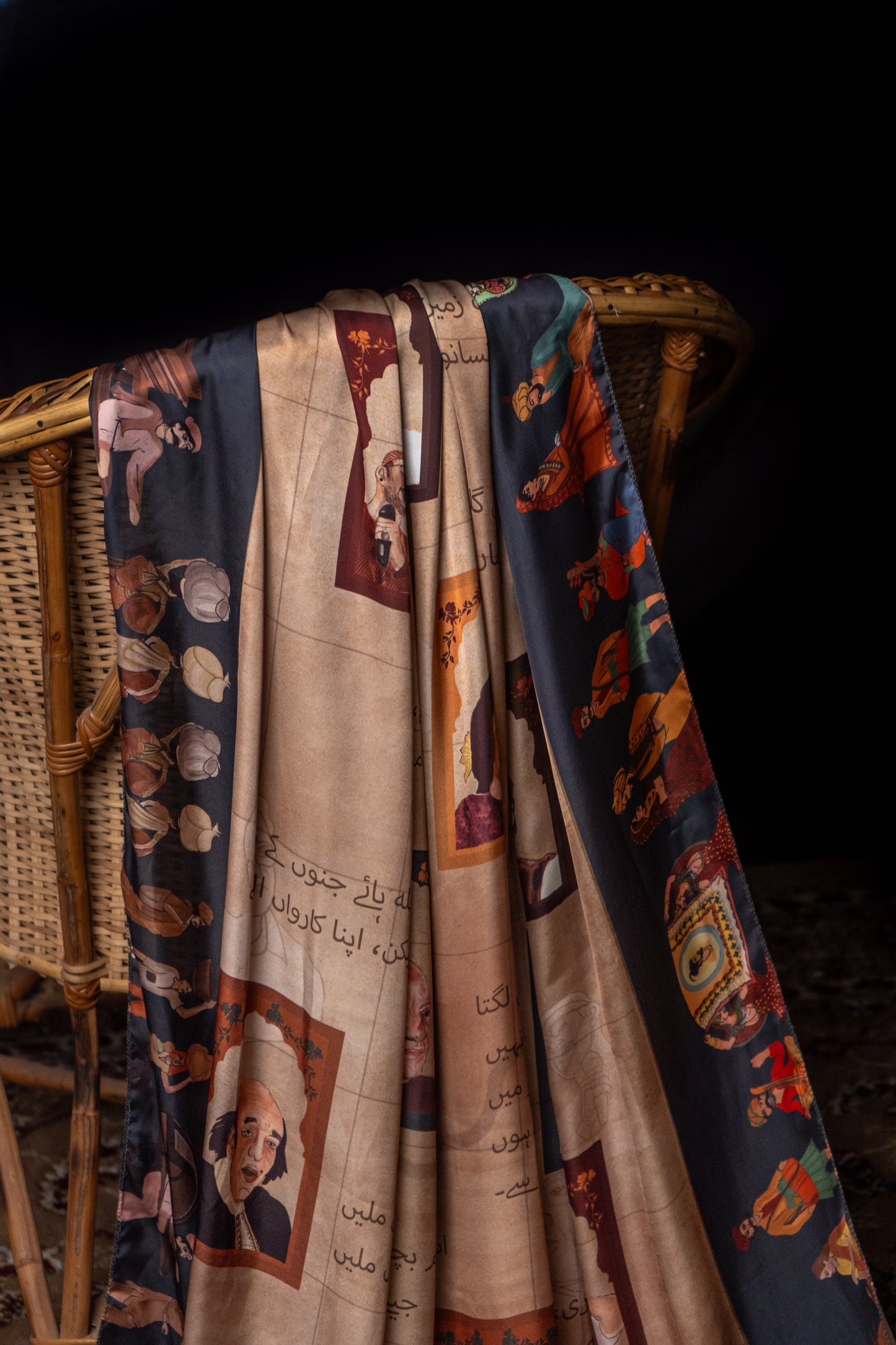
یہ داستان وراثتِ گفتگو کی ہے
جو ہماری ثقافت میں ضَمشُدہ ہے
یہ ہمارے ضمیر کا وہ حصہ ہے
جس سے ہم کبھی جُدا نہ ہو سکے
Sarhad (سرحد) Charmeuse Silk Scarf
Developed over 150 dedicated hours and nearly 100 hand-drawn motifs, this scarf visualizes a dialogue between the celebrated artists of Pakistan and India - voices once intertwined through shared culture, now separated by borders.
View full details
No file selected
Share

The Story
-
Legacy
Sarhad emerges from a profound reflection on the shared history and heritage that define the subcontinent. It is a journey that began centuries before us, weaving through generations to live within our present identity. Our brand explores narrative-based fabrics that do more than just clothe; they tell stories of a past that is collectively remembered and deeply felt across borders. By translating these historical echoes into tactile art, we bridge the gap between yesterday and today. Every thread is a testament to a legacy that remains unbroken by time, inviting you to wear a piece of a story that belongs to us all.
-
Memories
Each piece in this collection carries the weight of memories from pivotal eras of our history. From the opulence of the Mughal era and the stoic artistry of the Rajput period, the narrative moves toward the transformative time of migration. It speaks of the specific moment a line was drawn on a map, creating a sarhad—a physical boundary intended to divide India and Pakistan. This line separated land and people, yet it remained powerless against the flow of culture, art, and shared memory. Sarhad, the scarf, serves as a canvas for this complex history, reflecting the division while celebrating the enduring spirit that continues to transcend it.
-
Conversation
Within this narrative, artists exist in conversation across borders and time. Gulzar speaks of longing, and Mehdi Hassan replies through poetry. Faiz’s words stand as their own voice within the scarf, while Jagjit Singh’s ghazals form a separate presence in the narrative. Noor Jehan’s voice finds harmony with Lata Mangeshkar and Asha Bhosle. Abida Parveen carries the depth of devotion forward, while Ali Sethi and Shae Gill echo contemporary expressions shaped by the past. Sahir Ludhianvi and Saadat Hasan Manto remain in dialogue through truth, resistance, and memory.
About the Artist
Rabeea Jalal
I am a textile design student at Indus Valley School of Art and Architecture. My work is rooted in preserving and celebrating the shared artistic heritage of the subcontinent. As a textile design student, I draw inspiration from poetry, music, memory, and cultural narratives that transcend borders and time. Through my work, I translate stories of longing, devotion, and identity into wearable forms of art.